


Last Updated: maj 30, 2026
Short Answer
An OEM key is a licensing path, not automatically a fake key. The important buyer checks are edition match, device-binding expectations, transfer limits, seller clarity, and whether activation uses normal Microsoft systems.
- Check the exact product version and edition before buying or activating.
- Use Microsoft support pages for official activation behavior.
- Use WinProKeys support for order, delivery, setup, and common troubleshooting context.
Use this next
Open these guides before you choose a Windows key
Most readers do not need more product hype. They need a clear path for edition choice, license type, and a trustworthy seller.
- Windows 11 Home vs ProStart here if you still have not decided which edition fits the machine.
- Is an OEM key legal?Useful when a lower-cost listing mentions OEM but does not explain the trade-off.
- Is it safe to buy cheap Windows keys online?A practical trust check before you hand over payment details.
- Browse the live Windows key pagesUse the current product pages as the source of truth for offer and support details.
What Is an OEM Key?
If you’ve ever shopped for a Windows or Office product key, you’ve probably come across the term “OEM key” — often priced significantly lower than retail keys. But what exactly is an OEM key, and more importantly, is it legal to buy and use one?
In this guide, we’ll explain everything you need to know about OEM licenses in 2026: what they are, how they differ from retail keys, their legal status, and whether they’re the right choice for you.
OEM Explained: Original Equipment Manufacturer
OEM stands for Original Equipment Manufacturer. In the context of software licensing, an OEM key is a product key that was originally intended to be sold bundled with new hardware — typically a new PC, laptop, or motherboard.
When companies like Dell, HP, or Lenovo sell a computer with Windows pre-installed, they use OEM licenses purchased in bulk from Microsoft at a discounted rate. These licenses are meant to be tied to that specific piece of hardware for its lifetime.
Over time, a secondary market has developed where OEM keys are sold separately from hardware. This is where the legal questions come in.
Is It Legal to Buy an OEM Key?
The short answer: yes, in most jurisdictions, buying and using an OEM key is legal.
Here’s the longer explanation:
In the European Union
The landmark UsedSoft v Oracle ruling by the European Court of Justice (2012) established that software licenses can be legally resold after first sale. This principle, known as the “exhaustion of rights” doctrine, applies to OEM licenses as well. EU consumers have a clear legal right to purchase and use second-hand software licenses, including OEM keys.
In the United States
The first-sale doctrine under U.S. copyright law allows the resale of legitimately purchased copies of copyrighted works. While Microsoft’s End User License Agreement (EULA) states that OEM licenses are tied to the original hardware, courts have generally upheld consumers’ rights to resell software they’ve legally purchased. The legal landscape is more nuanced than in the EU, but purchasing an OEM key from a legitimate reseller is not illegal.
Microsoft’s Position
Microsoft’s official stance is that OEM licenses should only be sold with new hardware and are non-transferable. However, this is a licensing policy — not a law. Microsoft rarely pursues individual consumers who use OEM keys purchased separately. The keys themselves are software keys for the listed edition that activate through Microsoft activation systems.
OEM vs Retail Keys: What’s the Difference?
Understanding the differences helps you make an informed decision:
Transferability
- Retail Key — Can be transferred to a new PC. If you build a new computer, you can deactivate the key on your old machine and use it on the new one.
- OEM Key — Tied to the first PC it’s activated on. If you replace your motherboard or build a new PC, the key may not transfer. Major hardware changes can trigger reactivation issues.
Support
- Retail Key — Entitled to direct support from Microsoft for activation issues.
- OEM Key — Microsoft’s official policy is that OEM support comes from the hardware manufacturer (e.g., Dell, HP). In practice, Microsoft’s automated phone activation system works for OEM keys too.
Price
- Retail Key — Usually the higher-priced route when you buy direct from Microsoft or a major retailer.
- OEM Key — Usually lower-priced than retail, but tied more closely to the first machine it activates on.
Functionality
- Both key types activate the exact same version of Windows or Office. There is zero difference in features, performance, or updates between a system activated with an OEM key versus a retail key.
Are OEM Keys Genuine?
Legitimate OEM keys are properly sourced. They are created by Microsoft and activate through Microsoft’s official activation servers. When you enter an OEM key, Windows contacts the same servers it would for any retail key — and if the key is valid, your system is activated with a genuine license.
The risk isn’t about the keys being “fake” — it’s about where you buy them. Reputable sellers like WinProKeys source genuine OEM keys and stand behind every sale with activation guarantees.
When Should You Choose an OEM Key?
An OEM key is a great choice if:
- You’re building or setting up a PC that you plan to keep for several years
- You don’t anticipate major hardware changes (especially motherboard swaps)
- You want a genuine, fully-functional Windows license at the lowest possible price
- You’re setting up multiple PCs and need to keep costs down
When Should You Choose a Retail Key?
A retail key makes more sense if:
- You frequently upgrade or rebuild your PC
- You want the flexibility to transfer your license to a new machine
- You prefer having direct Microsoft support for activation issues
For a more detailed breakdown, check out our Windows product key types guide.
How to Avoid Scams When Buying OEM Keys
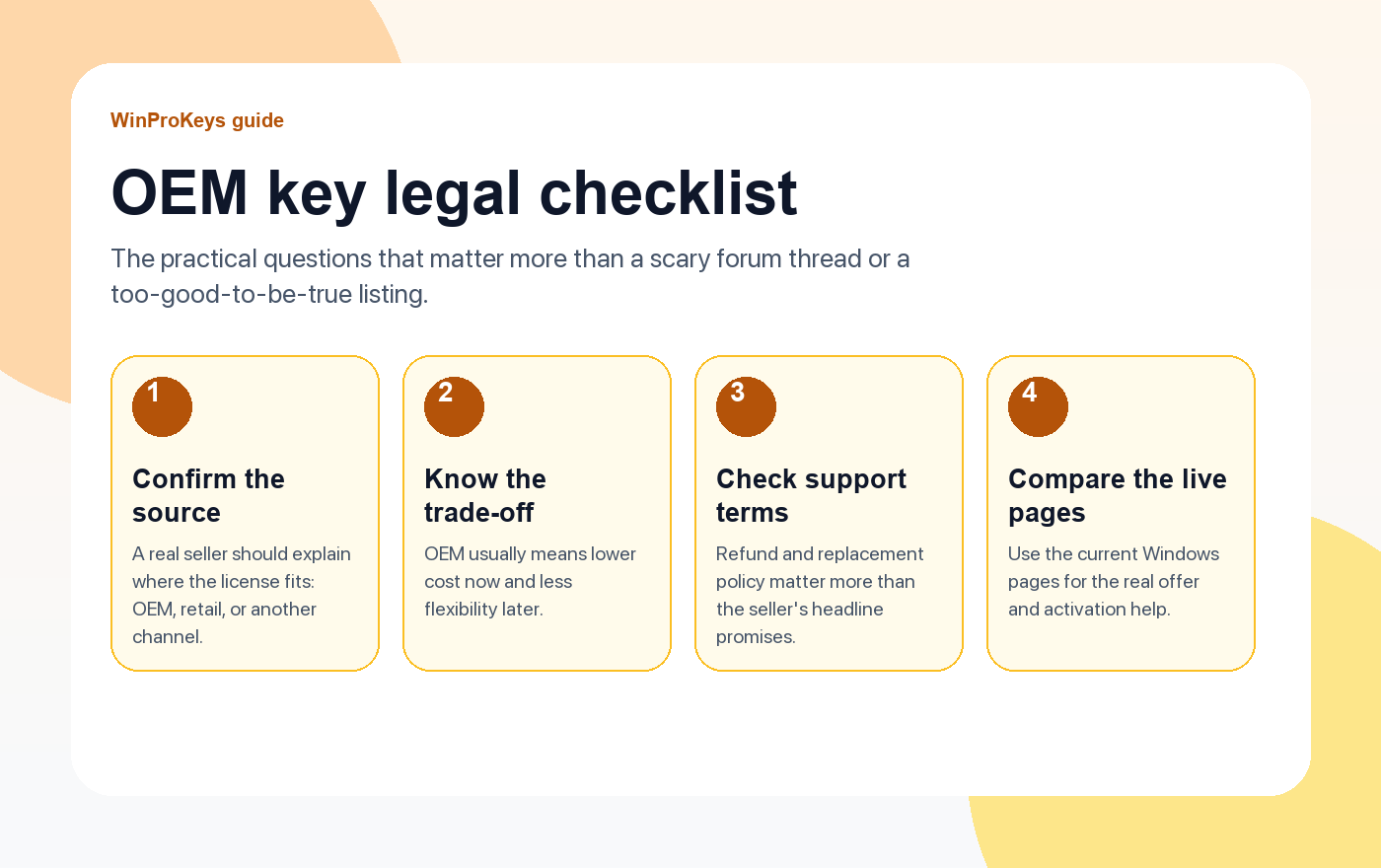
While OEM keys themselves are legitimate, not every seller is trustworthy. Here are some red flags to watch for:
- Prices that seem too good to be true — If the listing is so cheap it makes no licensing sense, the key is often recycled, unsupported, or already used.
- No refund or replacement policy — Reputable sellers offer guarantees. If a seller won’t stand behind their product, walk away.
- Delivery via suspicious channels — Legitimate sellers deliver keys through their website or email, not through random messaging apps.
- No customer support — If you can’t reach the seller after purchase, that’s a problem.
When you compare sellers, focus on activation guarantees, clear contact information, and a real replacement policy. If you want the current Windows pages, start with the Windows 11 Pro and Windows 11 Home product pages.
Frequently Asked Questions
Will Microsoft ban my account for using an OEM key?
No. Microsoft does not ban accounts for using OEM keys. These are genuine keys that activate through official channels. Your Microsoft account, OneDrive, and all associated services remain unaffected.
Can I use an OEM key to upgrade from Windows 11 Home to Pro?
Yes. If you have a Windows 11 Pro OEM key, you can use it to upgrade a Home installation to Pro through Settings → System → Activation. The upgrade process is the same regardless of whether the key is OEM or retail.
What happens if my motherboard fails and I need to replace it?
An OEM key is tied to your original hardware. A motherboard replacement may require reactivation. In many cases, Microsoft’s automated phone activation system will reactivate your key. If not, you may need to purchase a new key. This is the main trade-off of choosing OEM over retail.
Do OEM keys receive Windows updates?
Yes, absolutely. Systems activated with OEM keys receive the same Windows updates — including security patches, feature updates, and driver updates — as systems with retail keys. There is no difference.
Is it legal to resell an OEM key I’ve purchased?
In the EU, yes — the right of resale is well-established. In the US, the legal situation is less clear-cut but generally permissible under the first-sale doctrine. However, you can only resell a key that hasn’t been activated, or that has been properly deactivated.
The Verdict
OEM keys are product keys for the listed Windows edition that offer the same features and functionality as retail keys — at a much lower price. They are legal to purchase and use in most countries, with particularly strong legal protections in the EU. The main trade-off is that they’re tied to your hardware and can’t be easily transferred to a new PC.
For most users building or buying a PC they plan to keep for a few years, an OEM key is a smart, cost-effective choice. Just make sure you buy from a reputable seller.
Ready to get your genuine Windows key? Visit WinProKeys for affordable OEM and retail keys with instant email delivery and setup support.
Source and Support Links
Use Microsoft Support pages for general product behavior and activation context. Use WinProKeys pages for store delivery, order support, and reseller-specific guidance.
Frequently Asked Questions
What is the first thing to check for Is an OEM Key Legal??
Check the installed Windows edition first. A Home key and a Pro key are not interchangeable, and many activation problems begin with edition mismatch.
Is WinProKeys an Microsoft website?
No. WinProKeys is an independent software key reseller, not operated by Microsoft. Microsoft Support pages are the primary source for Windows activation behavior.
What should I send support if Windows activation fails?
Send the order email, installed Windows edition, exact error code, screenshot, and whether this is a new PC, reinstall, Home-to-Pro upgrade, or hardware change.
Need the live product pages?
If you have finished the guide and need the current Windows or Office pages, use the shop as the source of truth for pricing, delivery details, and activation help.
Open the shopChoose the product path that matches your device
These are the six Windows and Office routes we actively support most. Pick by edition fit first, then use the live product page for redemption steps, delivery timing, and post-sale support details.
If you are still deciding, use the Windows hub lub Office hub before checkout.


3 thoughts on “Is an OEM Key Legal? Everything You Need to Know in 2026”
Comments are closed.